Early modern interiors of the 1930’s were a celebration of material and craftsmanship, often utilising scale and proportion to manipulate spaces. There was playful rebellion amongst designers of this era, who took great joy in challenging perceptions of conventional interiors.

Silhouettes were curved, smooth and confident. In essence, combining bold shapes, and functionality of the Bauhaus movement, with warm toned timbers and soft upholstery. A new aesthetic was born.

Comfort, simplicity and practicality became the core principles of modern interior design, a firm break away from revivalist interiors. The movement endured a brief hiatus during WW2, returning mid-20th century with overwhelming popularity.
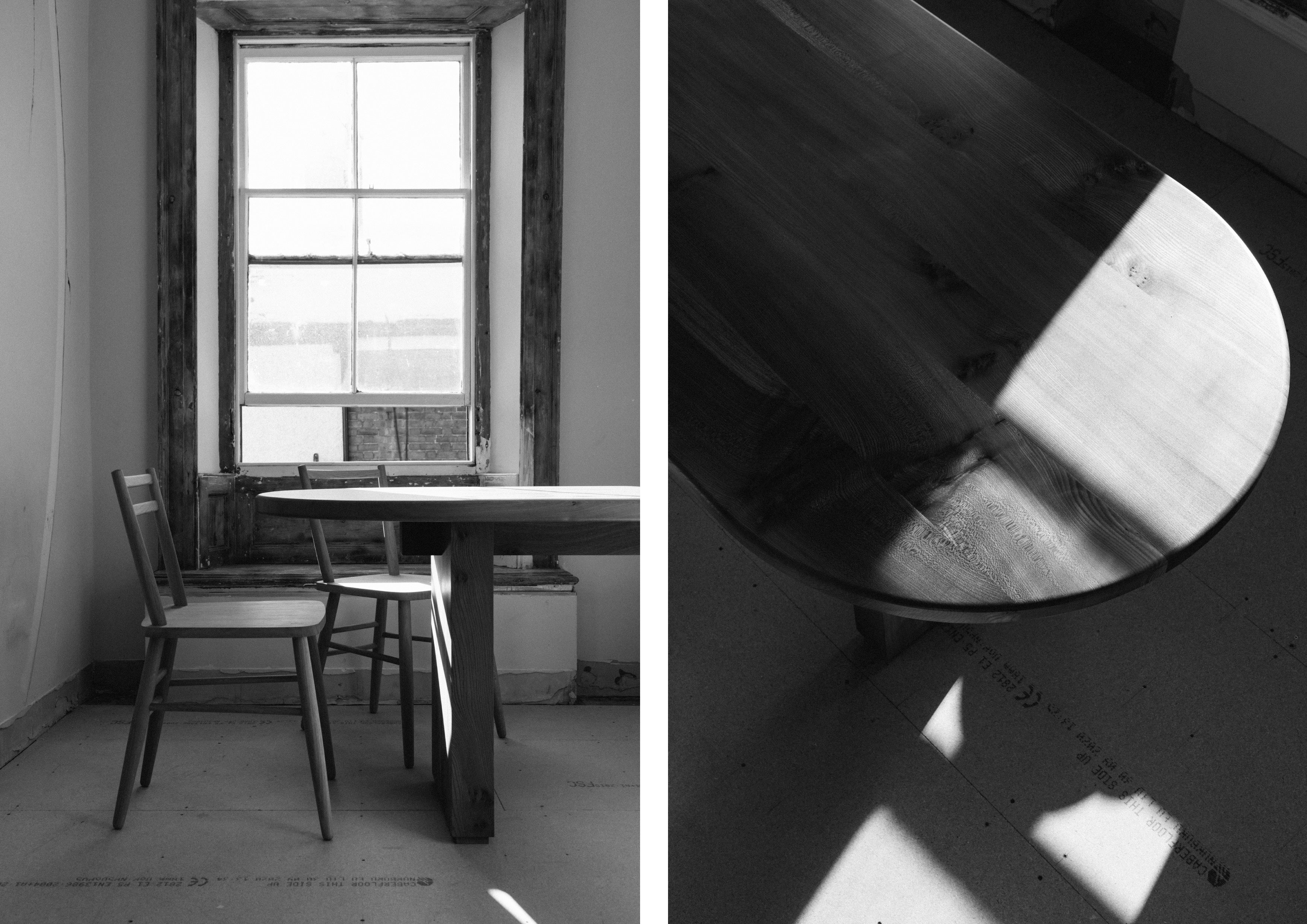
Our Capsule Ingot Dining Table pays a subtle nod to these early modern design principles, through warm tonal timbers and soft curves.
[>] Shop The Capsule Ingot Dining Table
The 61st Floor
In 1930, the celebrated and tenuous photographer Margaret Bourke-White took residency on the 61st floor of The Chrysler Building. Bourke-White commissioned her good friend and industrial designer, John Vassos to create a totally bespoke interior with an extensive collection of handcrafted furniture to echo the ultra modern Art Deco architecture of The Chrysler Building.
Vasso’s custom designs included an alcove desk, a built in bar below a cantilevered fish tank, and a conversation corner upholstered in Fabrikoid. The stairs, with a streamline, curved banister led to an outdoor terrace which Bourke White was forbidden to use, but would entertain out there, nonetheless. The terrace was also home to two American eagle gargoyles, where she would often clamber out, risking life and limb to photograph the Manhattan skyline.

John Vassos was an artist and a designer. His style became synonymous with early modern design, writing books, leading ad campaigns, designing forward thinking interiors and shaping the look of modern technology. His pioneering approach to modern design leaves an iconic legacy, even today.
[>] Read more about John Vassos.
Photography by Department Two, John Vassos and Marilyn Freeman's book, 'Making America Modern'